Thursday, June 22, 2017

FRANCE PROVIDES 100 MILLION EUROS TO PAKISTAN

FRANCE PROVIDES 100 MILLION EUROS TO PAKISTAN
Al-Bab Report


On June 21st, 2017, Mr. Tariq Mahmood PASHA, Secretary of Economic Affairs Division (EAD), Mr. René CONSOLO, Chargé d’Affaire a.i., Embassy of France, and Mr. Jacky AMPROU, Country Director of the French Agency for Development (AFD), signed the €100 million Credit Facility Agreement (CFA) for the Sustainable Energy Sector Reform Program. The Asian Development Bank has approved $300 million in cofinancing of the program.
 Power shortages are a major obstacle for Pakistan’s economy. With demand for electricity outpacing supply, inefficient and inadequate transmission and distribution systems have the potential to stifle growth and threaten social strife.

Under this program, Pakistan has embarked on a substantial reform initiative that aims to address financial sustainability issues in the energy sector. This includes recently passed legislation that will improve governance through more clearly defined roles for both the government and the energy sector regulator, reducing debt levels in the energy sector, and increasing investment.

The program also supports government efforts to improve market access for the private sector. Increased energy efficiency and the implementation of accountability and transparency measures are further actions that will support an increase in investment in the country’s power subsector.

Pakistan’s ambitious energy reform program demonstrates the government’s commitment to improving the reliability, sustainability, and affordability of the energy sector. Maintaining the momentum for reform will help ensure that all Pakistanis have access to electricity while keeping the economy on a high-growth path.

For the last ten years, France through the French Agency for Development has provided €610 million to support the Government’s strategy to solve the energy crisis and to fight climate change through investments in low-carbon-emission energy generation in line with COP21 Paris agreement approved by the Parliament of Pakistan.   

Tuesday, June 20, 2017

World Refugee Day

World Refugee Day
20 June 2017
Al-Bab Report


What is it like to flee war, disasters or persecution?

To leave everything behind?

More people than ever in our lifetimes are living this nightmare.

Their stories are heart-breaking. Hardship. Separation. Death.

I’ve met so many who have lost so much. But they never lose their dreams for their children or their desire to better our world.

They ask for little in return – only our support in their time of greatest need. And our solidarity. 

It is so inspiring to see countries with the least often doing the most for refugees.

On World Refugee Day, we reflect on the courage of those who have fled and the compassion of those who welcome them.

Let us resolve to re-establish the integrity of the international refugee protection regime.

And let us work to give everyone the chance to build a better future – together.


USAID and Ministry of Finance Renew Ongoing Cooperation for Development in Pakistan

USAID and Ministry of Finance Renew Ongoing Cooperation for Development in Pakistan
 Al-Bab Report


Islamabad, June 20, 2017The United States is providing an additional 19 billion Pakistani Rupees to create economic opportunities and pursue economic and political reforms that promote prosperity in Pakistan.
The additional funds will be obligated for development in Pakistan through an amendment to the Pakistan Enhanced Partnership Agreement signed recently by the U.S. Agency for International Development (USAID) and the Ministry of Finance.

The USAID programs to be supported through this agreement were developed in consultation with the Pakistani government and support the Government of Pakistan’s Vision 2025, which sets forth a roadmap for a prosperous Pakistan.  The agreement reaffirms the U.S. Government’s commitment to continue its engagement with Pakistan through bilateral cooperation and robust civilian and security assistance.  The additional funding will enable the U.S. and Pakistan to work jointly on issues that are important to both countries:  energy, economic growth, stability, governance, education, and health.

Between 2005 and 2016, the United States, through USAID, has provided nearly 840 billion Pakistani Rupees of development funds to Pakistan, making the country one of America’s largest recipients of foreign assistance.


Thursday, June 15, 2017

U.S. Embassy Leads Pakistani Delegation to International Franchise Expo

U.S. Embassy Leads Pakistani Delegation to International Franchise Expo
“Pakistan's economic growth is creating a strong market for U.S. brands.” – Steve Knode, U.S. Commercial Counselor


Islamabad, June 15, 2017: The U.S. Commercial Service (USCS) is leading this week a delegation of Pakistani companies from Karachi, Islamabad, and Mirpur to the International Franchise Expo 2017, in New York, USA.  The expo is the largest franchise expo in the United States and runs from June 15-17. More than 400 exhibitors, including leading U.S. franchise concepts in a variety of sectors, will display their newest services and products.

At the expo, Pakistani companies will have the opportunity to negotiate business deals with American franchise companies, bringing new high-quality entrants into the fast-growing Pakistani consumer market.  CS will support the Pakistani companies in attendance with Business-to-Business (B2B) matchmaking, and trade counseling.

Highlighting the importance of Pakistan’s participation in the Expo, American Commercial Counselor Steve Knode noted, “Many U.S. franchise concepts have opened and thrived in Pakistan, and I think there is demand for much more.  We are delighted to showcase other terrific U.S. franchise brands at IFE to our Pakistani delegation members, who we hope will one day bring America’s best products and services to Pakistan’s consumers.”

The United States is Pakistan’s largest trading partner, and in 2016, USCS led more than 200 Pakistani businesspeople to key U.S. trade shows, ranging from poultry products and waste management to information technology and solar power. 

The U.S. Commercial Service is the trade promotion arm of the U.S. Department of Commerce’s International Trade Administration. U.S. Commercial Service trade professionals in over 100 U.S. cities and in more than 75 countries help U.S. companies get started in exporting or increase sales to new global markets.


Wednesday, June 7, 2017

UNHCR and BUITEMS launched a centre for refugees and migration studies in Quetta

UNHCR and BUITEMS launched a center for refugees and migration studies in Quetta
Al-Bab Report


Quetta: The UN Refugee Agency (UNHCR) signed a partnership agreement with Balochistan University of Information Technology, Engineering and Management Sciences (BUITEMS) on Wednesday. The collaboration is aimed at establishing a Centre for Refugees and Migration Studies (CRMS) as well as the provision of training for refugee teachers and opportunities for entrepreneurship/business studies for refugee students in the university.

On the occasion, a plaque marking the establishment of the Centre was unveiled jointly by UNHCR Country Representative, Indrika Ratwatte, Chief Commissioner for Afghan Refugees Dr. Imran Zeb and BUITEMS Vice Chancellor, Engr. Ahmed Farooq Bazai.

Under the partnership agreement, UNHCR will support the university to establish a CRMS in its premises and BUITEMS would provide admission to the refugee students and training for the refugee teachers. Delivering an inaugural lecture titled “Management of Refugees and Migrants for Lasting Regional Peace”, Indrika Ratwatte praised the commitment of BUITEMS for providing opportunities for refugees terming it as an important step towards empowering youth and achieving broader goals for peace and prosperity in the region.

“Forced displacement is one of the biggest human crises the world is facing now. Pakistan has been generously hosting refugees for decades. It is therefore essential that all stakeholders come together to facilitate durable and lasting solutions for them.” Ratwatte maintained. 

Vice Chancellor BUTIMS, Ahmed Farooq Bazai stressed the need for quality education, research and academic exercises on socio-economic issues in the region including the challenges pertaining to refugees and migrants. The Vice Chancellor stated that BUITEMS is producing global citizens capable of finding tailored solutions to some of the compelling regional and global challenges. He assured that BUITEMS is fully prepared and upfront to support the national and international community in their endeavors.

The CRMS once operational will serve as a repository of information on issues related to refugees and migration, and analyze and disseminate that information to the wider audience. This will be achieved through regular publications of research works, talk programs and organizing periodic events like seminars/workshops which are expected to inform all stakeholders on issues surrounding refugees and migrants. It is expected that the outcomes of this collaboration between UNHCR and BUITEMS would assist policy and decision makers with concrete recommendations for addressing the actions needed towards the management of refugees and migrants in the region. UNHCR will also facilitate BUITEMS in its efforts to strengthen the center’s capacity by networking with other similar research centers and education institutions globally.

Chief Commissioner for Afghan Refugees Dr. Imran Zeb thanked UNHCR and BUITEMS for entering into this important collaboration which should help further nurture the existing harmonious relationship and understanding between refugee and host communities and enable sustainable solutions for refugees who have endured displacement for almost four decades. “Every refugee deserves a bright and safe future and providing such admirable opportunities would not only make refugees students and teachers productive in their homeland but valuable for securing peace in the region. This is actually a contribution to lead towards prosperous world for everyone”, he said.

The event was also attended by UNHCR Deputy Representative, Johann Siffointe; Head of UNHCR sub-office Quetta Dinesh Shrestha; Commissioner Afghan Refugees Quetta, Brig (R) Masood Ahmad; Afghan Consul General, Mr. Wajeedullah Momand; BUITEMS’s faculty members and students, and representatives of UN agencies and civil society.


Saturday, June 3, 2017

World Environment Day-2017

World Environment Day-2017

Al-Bab Report


The year 1972 marked a turning point in the development of international environmental politics: the first major conference on environmental issues, convened under the auspices of the United Nations, was held from June 5-16 in Stockholm (Sweden). Known as the Conference on the Human Environment, or the Stockholm Conference, its goal was to forge a basic common outlook on how to address the challenge of preserving and enhancing the human environment.

Later that year, on 15 December, the General Assembly adopted a resolution (A/RES/2994 (XXVII)) designating June 5 as World Environment Day and urging “Governments and the organizations in the United Nations system to undertake on that day every year worldwide activities reaffirming their concern for the preservation and enhancement of the environment, with a view to deepening environmental awareness and to pursuing the determination expressed at the Conference.” The date coincides with the first day of the Landmark Conference.

Also on 15 December, the General Assembly adopted another resolution (A/RES/3000 (XXVII)) that led to the creation of theUnited Nations Environment Programme (UNEP), the specialized agency on environmental issues.

Since the first celebration in 1974, the World Environment Day has helped UNEP to raise awareness and generate political momentum around growing concerns such as the depletion of the ozone layer, toxic chemicals, desertification and global warming. The Day has developed into a global platform for taking action on urgent environmental issues. Millions of people have taken part over the years, helping drive change in our consumption habits, as well as in national and international environmental policy.

Thursday, June 1, 2017

Canada funds strategic humanitarian response facility in Gilgit

Canada funds strategic humanitarian response facility in Gilgit, Pakistan
Al-Bab Report


Islamabad – The United Nations World Food Programme (WFP) is constructing a Humanitarian Response Facility (HRF) in the Gilgit-Baltistan (GB) –the northern area of Pakistan, thanks to funding from the Government of Canada. This will be the seventh HRF built in Pakistan as part of a strategic network of storage facilities to help the Government and humanitarian community better prepare for and respond to disasters.

WFP has been working with the National Disaster Management Authority (NDMA) and the Provincial Disaster Management Authorities (PDMA) to build HRFs in strategic locations in the most vulnerable parts of Pakistan. HRFs provide a central storage facility for government relief stocks to be rapidly deployed in emergencies. While WFP designs and builds the HRFs, the Government provides land for construction and takes over operation and maintenance. WFP provides training to government staff in technical areas such as warehouse management, facilities management, and firefighting.

The Government of Canada is providing CDN$2.2 million (1.7 million USD) for the construction of the HRF in GB. This comes in addition to just over CDN$4.4 million in contributions for the construction of six other HRFs located in Muzaffargarh, Quetta, Lahore, Hyderabad, Peshawar, and Sukkur, jointly with five other donor nations.

With an estimated population of 2 million, GB has a hilly terrain with few roads that are often blocked during emergencies by landslides, damage to bridges or congestion, leaving communities isolated. Instead of having to resort to aerial operations, which are expensive and can only bring a limited volume of assistance, the HRF will provide a central storage hub for critical humanitarian supplies. WFP has already established Emergency Storage Facilities at the district level in GB. The construction of this HRF will provide a central storage hub for the movement of critical humanitarian supplies.

The Government of Canada is also contributing approximately CDN$1.2 million to address the immediate needs of highly vulnerable families in the drought-affected Tharparkar district of Sindh, through activities such as structural asset creation and training on how to prepare for and cope with disasters.

Sunday, May 28, 2017

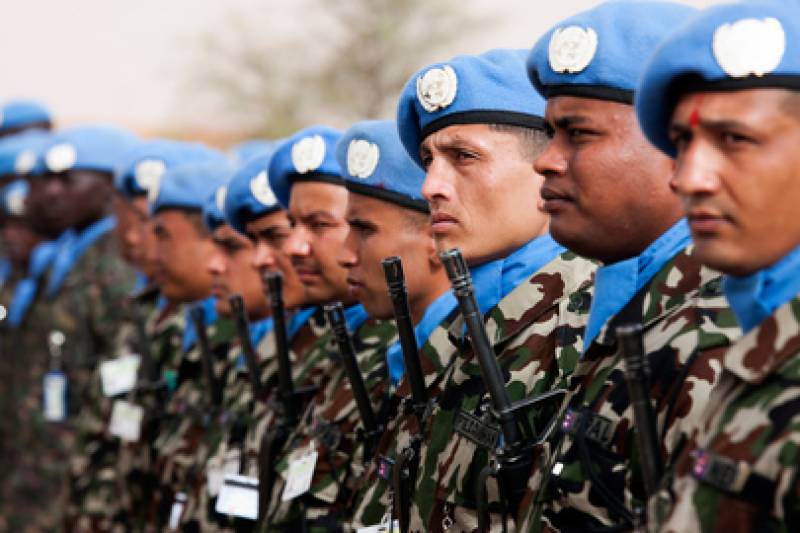
International Day of UN Peacekeepers

International Day of United Nations Peacekeepers
29 May 2017
Al-Bab Report


“Investing in Peace Around the World”

For nearly 70 years, UN peacekeeping has proven to be one of the international community’s most effective investments in peace, security, and prosperity. 

Demand for UN peacekeepers has risen steadily over the years, and deployment is now near an all-time high. Peacekeeping has had a positive impact on the lives of millions of people around the world.

Despite their different sizes and mandates, all UN missions have the same goals: to save lives, protect people, to set the stage for peace, and then close.  They are intended to be short-term investments that provide long-term dividends by creating the time and space for political processes to unfold. 

To date, fifty-four UN peace operations have completed their mandates. Two more, in Cote d’Ivoire and Liberia, will soon close, joining a long list of successful operations in Angola, Cambodia, Croatia, El Salvador, Guatemala, Namibia, Sierra Leone, Timor-Leste and elsewhere.

Looking forward, we are aiming to do more to end operations that have achieved their goals. We are also reforming and adapting our peacekeeping missions to improve their effectiveness in the increasingly challenging environments in which they work.

Today’s peacekeeping budget -- less than one -half of one percent of global military spending -- is money well spent. It is a fraction of the cost of allowing conflict to spread and erode the gains of economic development. The investment is multiplied by the economic growth and prosperity that follow from stability and security after successful peacekeeping missions.

The UN is working hard to make all our peacekeeping operations cost-effective from start to finish. We are constantly finding ways to reform, restructure and drive costs down.

At the same time, UN peacekeepers are relentless in searching for new ways to build sustainable peace.

Peacekeeping operations have evolved from simply monitoring ceasefires to protecting civilians, disarming ex-combatants, protecting human rights, promoting the rule of law, supporting free and fair elections, minimizing the risk of land mines and much more.  They also work to ensure that women are fully represented in peace processes, political life, and in branches of government. All these investments are fundamental to building lasting peace.

Since taking office earlier this year, I have made ending the scourge of sexual exploitation and abuse committed by UN personnel, including peacekeepers, one of my top priorities. We are by no means perfect. But when we make mistakes, we learn from them, striving continuously to deploy our personnel and assets in a way that is not just responsible, but beneficial to the people and communities we serve.

I look forward to working with the Member States on this.  Our partnership is central to the success of peacekeeping missions since the Member States decide where troops go, what they will do, and what resources will support them. Our close cooperation is vital if we are to deliver on the promise of lasting peace, while peacekeepers create conditions on the ground to enable solutions to emerge and take root.

I have also prioritized ensuring that women play a far more active role in peace operations, as troops, police and civilian staff. Gender parity is essential for its own sake, and the presence of women increases the chances of sustained peace while reducing incidences of sexual abuse and exploitation.

On this International Day of UN Peacekeepers, we pay tribute to more than 113,000 ‘Blue Helmets’, UN Police and civilian personnel deployed to 16 missions.  We acknowledge the contribution made by an ever-growing number of Member States to our operations.  We thank more than one million women and men who have served under the UN flag with professionalism, dedication, and courage throughout our history. And we honor the memory of more than 3,500 peacekeepers who lost their lives while serving.

Last year, 117 peacekeepers paid the ultimate price. They included military, police, international civil servants, UN Volunteers and national staff from 43 countries. So far in 2017, twelve peacekeepers have been killed.

Their efforts on behalf of the international community are one of the most concrete expressions of the UN Charter’s determination “to save succeeding generations from the scourge of war.” We all owe them a great debt.


Wednesday, May 24, 2017

U.S. Embassy Donates Law Enforcement Equipment and Vehicles to Islamabad Police

U.S. Embassy Donates Law Enforcement Equipment and Vehicles to Islamabad Police
and the Pakistan National Police Bureau
Al-Bab Report


Islamabad, May 23, 2017 – High ranking Pakistani police officials received law enforcement counter-terrorism related equipment at an event held at Islamabad Police lines HQ today.  The equipment handed over at the ceremony included vehicles, communication equipment, uniforms, and Crisis Response Team equipment, valued at over $1 million dollars.  The event was presided over by Deputy Inspector General Islamabad Police Ashrif Zubair Saddiqi, with the American Embassy represented by Deputy Regional Security Officer Rob Meyer. 

The donations are being provided by the U.S. Department of State’s Anti-Terrorism Assistance (ATA) program, which provides training and equipment to law enforcement personnel throughout the world.  The ATA has partnered with Pakistani law enforcement agencies at the provincial and federal level since 2003 to strengthen Pakistan’s counter-terrorism capabilities, training well over three thousand officers from various law enforcement agencies throughout Pakistan, and has previously donated approximately $3.3 million USD in equipment to Pakistan since the inception of the program. 

Monday, May 22, 2017

UN Headquarters Observes International Day of United Nations Peacekeepers

UN Headquarters Observes International Day of United Nations Peacekeepers
Al-Bab Report


-- 5 fallen peacekeepers from Pakistan to be honored at ceremony at UN Headquarters –

The United Nation Headquarters will observe the International Day of United Nations Peacekeepers Wednesday, 24 May.  Secretary-General Antonio Guterres will lay a wreath to honor all fallen peacekeepers and will preside over a ceremony at which the Dag Hammarskjöld Medal will be awarded posthumously to 117 military, police and civilian personnel who lost their lives while serving in peacekeeping operations during 2016. 

Five fallen peacekeepers from Pakistan are among the 117 who will posthumously receive the Dag Hammarskjold medal  --  Havildar Abdul Majeed Khan and Havildar Zishan Ahmed, who served with the United Nations Organization Stabilization Mission in the Democratic Republic of the Congo (MONUSCO ); Lt-Colonel Muhammad Ashraf, who served with the  United Nations Operation in Cote d’Ivoire (UNOCI); Naik Qaiser Abbas, who was deployed with the United Nations Multidimensional Integrated Stabilization Mission in the Central African Republic  (MINUSCA); and Ms. Sjabnam Khan who served in a civilian capacity with the United Nations Assistance Mission in Afghanistan (UNAMA).

In a video message to mark the Day, the Secretary-General said:  “Every day, peacekeepers help bring peace and stability to war-torn societies around the world.  On the International Day of United Nations Peacekeepers, we pay tribute to the more than 3,500 peacekeepers who have given their lives in the service of peace since 1948.” 
                                         
He further said: “Their sacrifice only strengthens our commitment to ensuring that United Nations peacekeepers continue protecting civilians in harm’s way, promoting human rights and the rule of law, removing land mines, advancing negotiations and securing a better future in the places they are deployed.  Now, more than ever, it is essential that we continue investing in peace around the world.”

Jean-Pierre Lacroix, Under-Secretary-General for Peacekeeping Operations, said: “We pay our greatest respects to the committed and courageous peacekeepers who are no longer with us today. I offer my deepest and most sincere condolences to the families of those we honor and to the bereaved. It’s critical that we continue to invest in peace and make every effort to carry forward their noble work, and that we continue to pursue reform efforts to make United Nations peacekeeping more efficient and effective. That is the best way we can honor the memories and sacrifices of our fallen peacekeepers."
Today, more than 96,000 uniformed personnel from 124 troop-and-police-contributing countries serve under the blue flag, alongside more than 15,000 international and national civilian staff and nearly 1,600 United Nations Volunteers.
Pakistan is the 3rd largest contributor of military and police personnel to UN peacekeeping.  It currently deploys more than 7,100 uniformed personnel to the UN peace operations in the Central African Republic, Cote d’Ivoire, the Democratic Republic of the Congo, Haiti, Liberia, South Sudan, Sudan and the Western Sahara.

The International Day of United Nations Peacekeepers was established by the General Assembly in 2002, to pay tribute to all men and women serving in peacekeeping, and to honor the memory of those who have lost their lives in the cause of peace.  The Assembly designated 29 Mayas the Day because it was the date in 1948 when the United Nations Truce Supervision Organization (UNTSO), the world body’s first peacekeeping mission, began operations in Palestine.  


While the Day will be marked in New York on the 24th, UN Peacekeeping operations and UN offices around the world will commemorate the Day on or around the 29th

American Ambassador David Hale meets with Chief of Army Staff General Qamar Javed Bajwa

American Ambassador David Hale meets with Chief of Army Staff General Qamar Javed Bajwa
Al-Bab Report


Islamabad, May 22, 2017 — American Ambassador David Hale met today with Chief of Army Staff General Qamar Javed Bajwa.

Ambassador Hale noted President Donald Trump’s call during his speech at the Arab-Islamic-American Summit for a vision of peace, security, and prosperity, and unity in conquering extremism and terrorism. Ambassador Hale affirmed Pakistan’s role and great sacrifices in this effort. 

Ambassador Hale thanked General Bajwa for his public commitment on May 18 that Pakistan is taking measures to ensure that militants do not use Pakistan’s soil to conduct attacks against any country.  In this vein, during their meeting, General Bajwa offered renewed assurances that Pakistan would not permit its territory to be used to plan or conduct attacks against Afghanistan.  The Ambassador and General Bajwa reiterated their nations’ commitment to a secure, stable, and prosperous Afghanistan.

U.S. Ambassador Blome’s Meeting with Deputy Prime Minister and Foreign Minister Ishaq Dar

U.S. Ambassador Blome’s Meeting with Deputy Prime Minister and Foreign Minister Ishaq Dar The below is attributable to U.S. Mission Spokes...